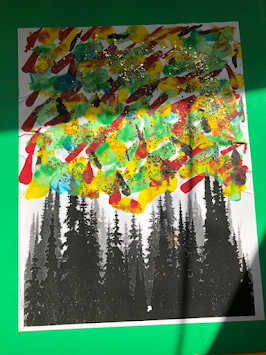
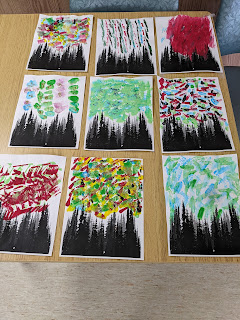
I'm still at the same home, but something I'm super pleased and proud of is our art gallery we'll be hosting at the home in a couple weeks. Here're some artists works:
I have only posted photos of art without names of residents to protect their privacy.
This was a spur of the moment idea because we had so little time to plan a better arts and crafts program. I got this idea off of activity connection, did it with my residents, and then said to my coworker, "wouldn't it be nice if we just collected their art and then showcased them in an art gallery in the home?" Which lead to our new plan: September art showcase with "in residence" artists on display. You just never know what a boring craft program could lead to! Also, all of these people have dementia of some form or another, but look at the expression in their painting.
As much as I am ok with death, I am also very not ok with it. Weird eh? I'm in a field where death is eminent and ready to happen at any given moment. Someone died today, and I was disappointed. I didn't have a close relationship to said person, but it still came on suddenly and shocked us all. I am ok with her passing, but also not ok with it. Death is natural, and inevitable and also (in my opinion) a private and human right. But it still shocks us, angers us and bereaves the loved ones. We learned in school about death, dying and bereavement. I found it mostly boring, but that was thanks to the subject material and the instructor. (sorry!) I found the studies on M.A.I.D in Canada thought provoking and insightful. I also enjoyed learning about cultures and how they grieve or view death. That doesn't mean being in long-term care and being surrounded by death is easy for anyone. People were in tears today, as would be expected. A group gathered to pay their respects. A la...
I don't know how many days I've been working with person A on doing some simple dementiability interventions, but it has been monumentally successful. There are some things to consider however. First of all, this model doesn't guarantee success with every person. They say that in their workshops. There is no 100% success model for all human beings. We all know that. Secondarily, I think the person I work with and I have a lot of characteristics in common. We both like consistency and familiarity, and we get nervous easily when things change that are out of our control. This has accounted for quite a lot of my success with her. I can't guess how it might have failed or needed something different on my part with anyone else. Having said that, I have found success using the following: -Folding her own apron after every meal I assist her with. -Utilizing her background that I know about (in her medical profile) to bring activities that provide meaning and utility, en...


Comments
Post a Comment